Step 4: Add Metadata and Analyze Spatial Patterns
This notebook turns metric results into spatial summaries. You will use PGA and FAS as two separate examples, so you can see how the same spatial tests can highlight different model-performance patterns for different metrics.
Imports
These functions prepare metric fields and calculate spatial summaries.
[1]:
from spatial_vtk.config.notebook import notebook_timer, register_svtk_cell_timer

with notebook_timer():
    import os

    os.environ.setdefault("LOKY_MAX_CPU_COUNT", "1")

    from pathlib import Path
    import pandas as pd
    from IPython.display import Markdown, display

    from spatial_vtk.config import SpatialVTKConfig
    from spatial_vtk.config.labels import metric_display_name
    from spatial_vtk.io import read_config_table, write_output_tables
    from spatial_vtk.spatial.calculate import (
        bootstrap_contrast_table,
        build_distance_bin_summary,
        build_metric_field,
        build_station_feature_table,
        center_field_by_event,
        compute_global_morans_i,
        compute_pca_spatial_modes,
        moran_result_to_frame,
        normalize_metrics_table,
        run_residual_feature_clustering,
        summarize_station_bias,
    )
    from spatial_vtk.spatial.map import plot_residual_grid, plot_station_bias_map
    from spatial_vtk.spatial.map.pca import plot_pca_summary
    from spatial_vtk.spatial.plot import plot_distance_correlation_by_metric, plot_geology_contrast
    register_svtk_cell_timer()
Run time: 1.42 s
Configuration
Load the config and read the spatial-statistics settings from the tutorial run scenario.
[2]:
# Use the repository root so paths match the public source checkout.
from spatial_vtk.tutorials import tutorial_root
repo_root = tutorial_root()
# Metadata table paths are project-relative.
import os
os.chdir(repo_root)
config_path = repo_root / "data/examples/configuration/example_spatial_vtk_config.yaml"

# Load the tutorial run scenario and make it the active config for later package calls.
cfg = SpatialVTKConfig.from_file(config_path, run_scenario="tutorial").activate()

# Use the native ln metric results calculated in Step 3.
figure_dir = cfg.path("outputs.figures")
figure_dir.mkdir(parents=True, exist_ok=True)
spatial_metrics = ("PGA", "FAS")
spatial_metric_labels = {"PGA": "Peak acceleration (PGA)", "FAS": "Fourier amplitude spectrum (FAS), 3 s"}
spatial_value_column = "ln_residual"
Run time: 13.0 ms
Prepare Metric-Specific Spatial Fields
Spatial statistics use one value per event-station observation, plus station and event coordinates. Here you will build those fields separately for PGA and FAS. Use Z-component PGA in the 1–2 s passband and FAS at 3 s from the independent 1 Hz lowpass calculation. Each field has one observation per event and station; periods, components and passbands are not pooled.
[3]:
# Use the native ln metric results calculated in Step 3.
from spatial_vtk.io import load_output_table
metrics = load_output_table("metrics_enriched")
metrics = metrics.loc[
    metrics["component"].eq("Z") & (
        (metrics["metric"].eq("PGA") & metrics["passband"].eq("1-2 sec")) |
        (metrics["metric"].eq("FAS") & metrics["period_s"].eq(3.0) & metrics["passband"].eq("lowpass 1 Hz"))
    )
].copy()
assert not metrics.duplicated(["event_id", "station", "metric"]).any()

# Read the configured site/geology metadata table.
site_metadata = read_config_table("paths.site_metadata")

# Normalize metric columns so spatial-statistics helpers see consistent names.
spatial_ready = normalize_metrics_table(metrics)

spatial_products = {}
for metric_name in spatial_metrics:
    display(Markdown(f"### {spatial_metric_labels[metric_name]}"))

    # Build one event-station field for this metric using ln(observed/synthetic) residuals.
    field = build_metric_field(spatial_ready, metric=metric_name, value_column=spatial_value_column)

    # Remove each event mean before comparing persistent station patterns.
    centered = center_field_by_event(field)

    # Summarize each station's mean event-centered residual for this metric.
    station_bias = summarize_station_bias(centered)

    spatial_products[metric_name] = {
        "field": field,
        "centered": centered,
        "station_bias": station_bias,
    }

    display(
        pd.DataFrame(
            {
                "Output": ["Metric field", "Event-centered field", "Station bias"],
                "Rows": [len(field), len(centered), len(station_bias)],
                "Events": [field["event_id"].nunique(), centered["event_id"].nunique(), ""],
                "Stations": [field["station"].nunique(), centered["station"].nunique(), station_bias["station"].nunique()],
            }
        )
    )
    display(station_bias.head())

metric_field = pd.concat([item["field"] for item in spatial_products.values()], ignore_index=True)
event_centered_residuals = pd.concat([item["centered"] for item in spatial_products.values()], ignore_index=True)
station_bias = pd.concat([item["station_bias"].assign(metric=metric_name) for metric_name, item in spatial_products.items()], ignore_index=True)

# Save the core spatial-statistics handoff tables for later notebooks.
write_output_tables(
    metric_field=metric_field,
    event_centered_residuals=event_centered_residuals,
    station_bias=station_bias,
)
Peak acceleration (PGA)
| Output | Rows | Events | Stations | |
|---|---|---|---|---|
| 0 | Metric field | 115 | 5 | 30 |
| 1 | Event-centered field | 115 | 5 | 30 |
| 2 | Station bias | 30 | 30 |
| station | lat | lon | n_events | mean_centered | median_centered | std_centered | sem_centered | abs_mean_centered | bias_zscore | |
|---|---|---|---|---|---|---|---|---|---|---|
| 7 | CRN | 33.876 | -117.561 | 3 | -1.989584 | -2.043541 | 0.741681 | 0.428210 | 1.989584 | -4.646286 |
| 17 | IVY | 33.760 | -117.477 | 4 | 1.130737 | 1.021022 | 0.442097 | 0.221049 | 1.130737 | 5.115333 |
| 6 | CRF | 33.874 | -118.039 | 1 | 0.860199 | 0.860199 | NaN | NaN | 0.860199 | NaN |
| 16 | GSA | 34.137 | -118.128 | 3 | 0.792946 | 0.489647 | 0.717965 | 0.414517 | 0.792946 | 1.912937 |
| 13 | FON | 34.100 | -117.439 | 4 | -0.791733 | -0.720329 | 0.371544 | 0.185772 | 0.791733 | -4.261847 |
Fourier amplitude spectrum (FAS), 3 s
| Output | Rows | Events | Stations | |
|---|---|---|---|---|
| 0 | Metric field | 140 | 5 | 30 |
| 1 | Event-centered field | 140 | 5 | 30 |
| 2 | Station bias | 30 | 30 |
| station | lat | lon | n_events | mean_centered | median_centered | std_centered | sem_centered | abs_mean_centered | bias_zscore | |
|---|---|---|---|---|---|---|---|---|---|---|
| 2 | BLC | 34.24400 | -118.67300 | 4 | 1.069910 | 0.818259 | 0.834631 | 0.417315 | 1.069910 | 2.563792 |
| 7 | CRN | 33.87600 | -117.56100 | 4 | -0.882931 | -0.581021 | 0.685306 | 0.342653 | 0.882931 | -2.576748 |
| 27 | MWC | 34.22400 | -118.05800 | 3 | -0.868699 | -0.499090 | 0.692043 | 0.399551 | 0.868699 | -2.174189 |
| 20 | LCG | 34.00033 | -118.37794 | 5 | 0.834246 | 0.490915 | 0.796891 | 0.356381 | 0.834246 | 2.340884 |
| 26 | MLS | 34.00500 | -117.56200 | 5 | 0.816817 | 0.736142 | 1.236567 | 0.553009 | 0.816817 | 1.477040 |
[3]:
{'metric_field': PosixPath('/home/runner/work/spatial-vtk/spatial-vtk/outputs/tutorials/tables/metric_field.parquet'),
 'event_centered_residuals': PosixPath('/home/runner/work/spatial-vtk/spatial-vtk/outputs/tutorials/tables/event_centered_residuals.parquet'),
 'station_bias': PosixPath('/home/runner/work/spatial-vtk/spatial-vtk/outputs/tutorials/tables/station_bias.parquet')}
Run time: 189.3 ms
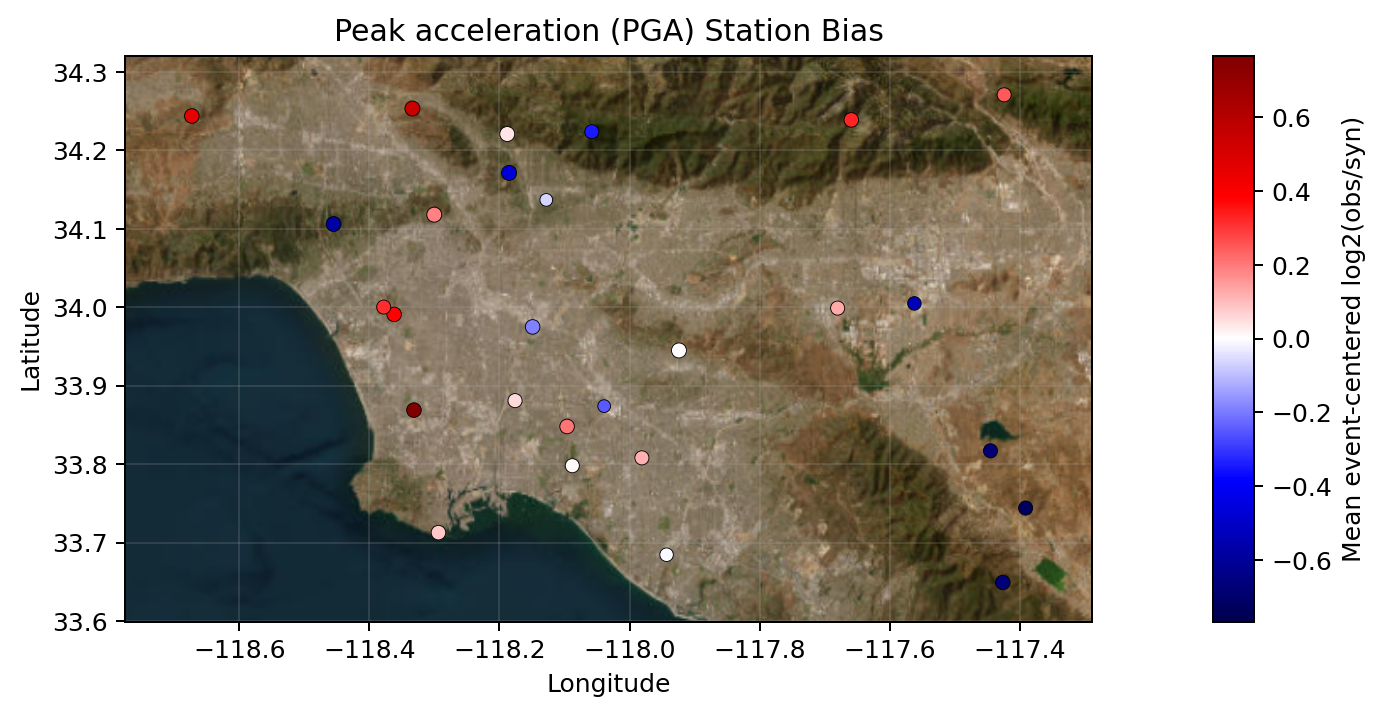
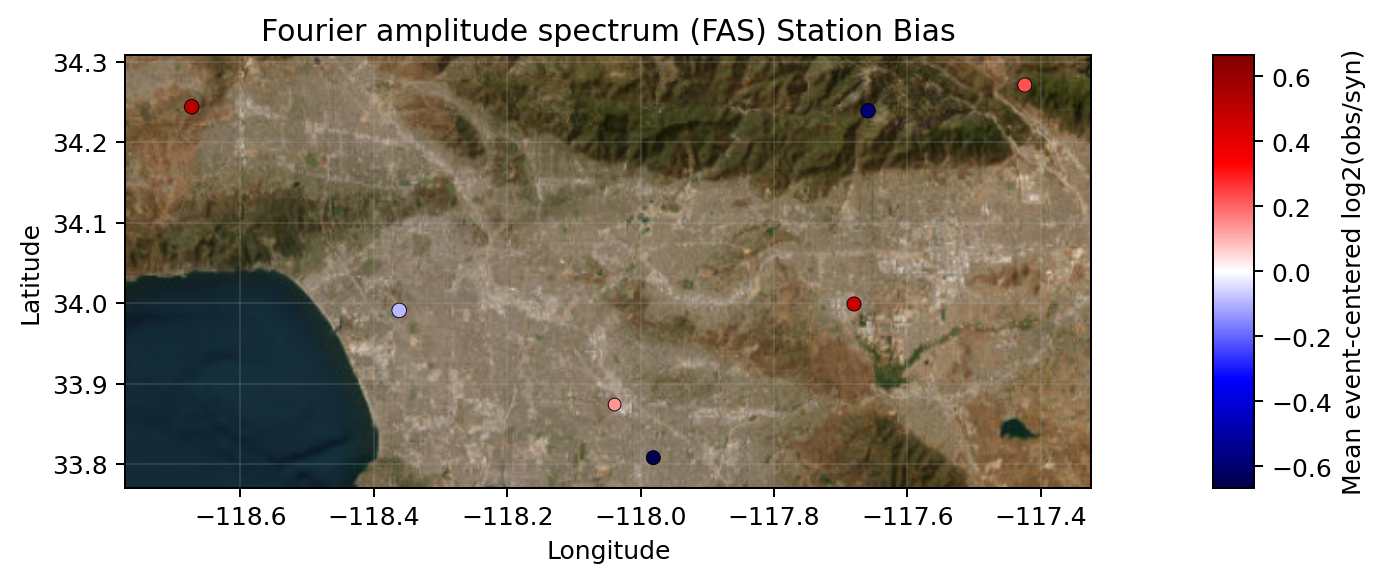
Station Bias Maps
These maps show the mean event-centered residual at each station. Positive values mean the observed amplitudes are larger than the synthetic amplitudes on average for that metric.
[4]:
for metric_name, products in spatial_products.items():
    display(Markdown(f"### {spatial_metric_labels[metric_name]}"))

    # Map the mean event-centered residual at each station for this metric.
    station_bias_fig = plot_station_bias_map(
        products["station_bias"],
        title=f"{spatial_metric_labels[metric_name]} Station Bias",
        value_col="mean_centered",
        value_label="Mean event-centered ln(obs/syn)",
        add_basemap=True,
        showfig=True,
        savefig=True,
        outpath=figure_dir / f"step_04_{metric_name.lower()}_station_bias.png",
    )
Peak acceleration (PGA)
Fourier amplitude spectrum (FAS), 3 s
Run time: 3.13 s
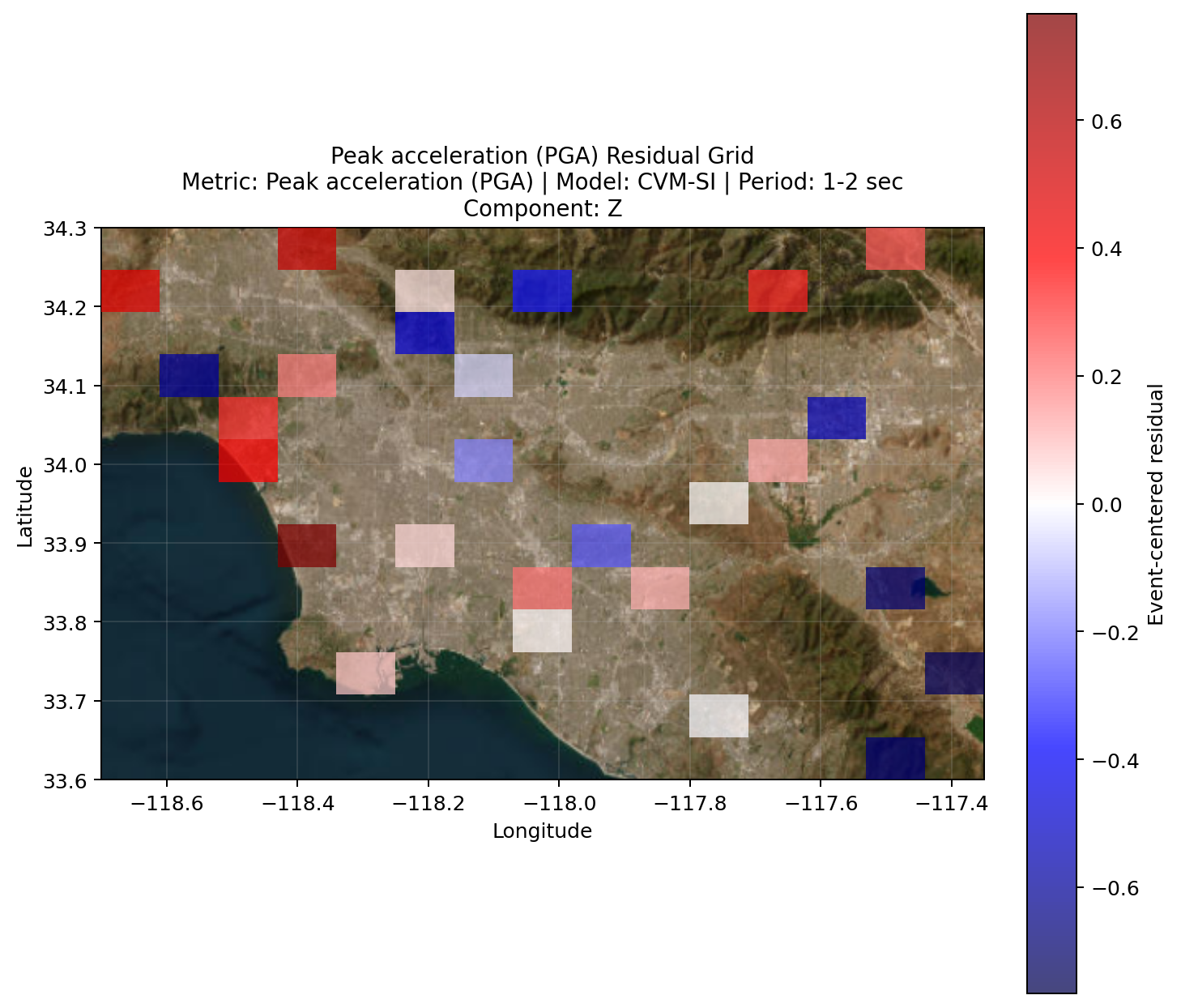
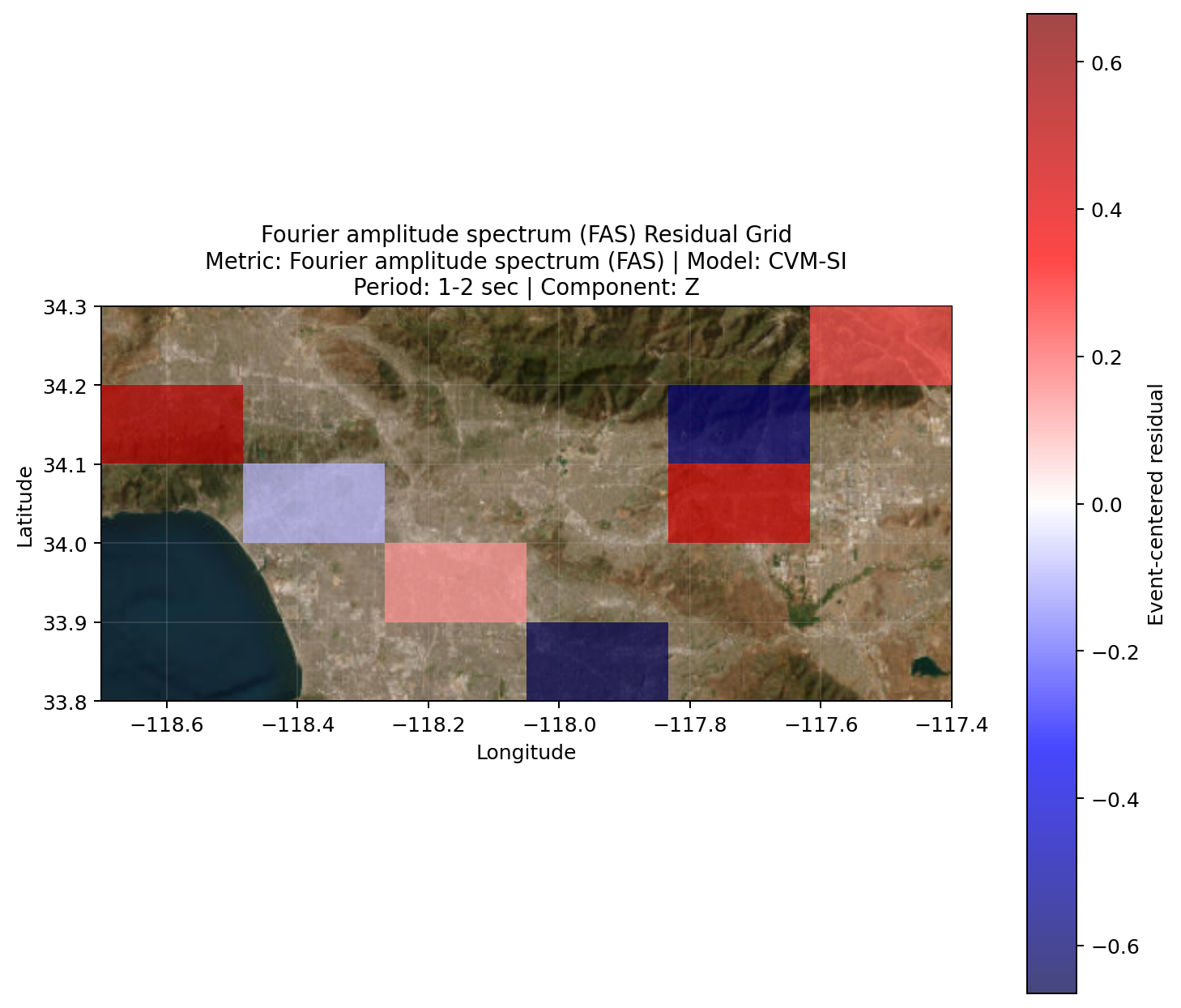
Residual Grid Maps
A residual grid gives you a quick spatial overview of where residuals are broadly positive or negative. These examples use the same event-centered residual field as the station-bias maps.
[5]:
for metric_name, products in spatial_products.items():
    display(Markdown(f"### {spatial_metric_labels[metric_name]}"))

    # Grid event-centered residuals onto lon/lat cells for a broader spatial view.
    residual_grid_fig = plot_residual_grid(
        products["centered"],
        lon_col="lon",
        lat_col="lat",
        value_col="field_centered",
        cell_size_deg=0.05,
        title=f"{spatial_metric_labels[metric_name]} Residual Grid",
        add_basemap=True,
        showfig=True,
        savefig=True,
        outpath=figure_dir / f"step_04_{metric_name.lower()}_residual_grid.png",
    )
Peak acceleration (PGA)
Fourier amplitude spectrum (FAS), 3 s
Run time: 3.52 s
Spatial Correlation Tests
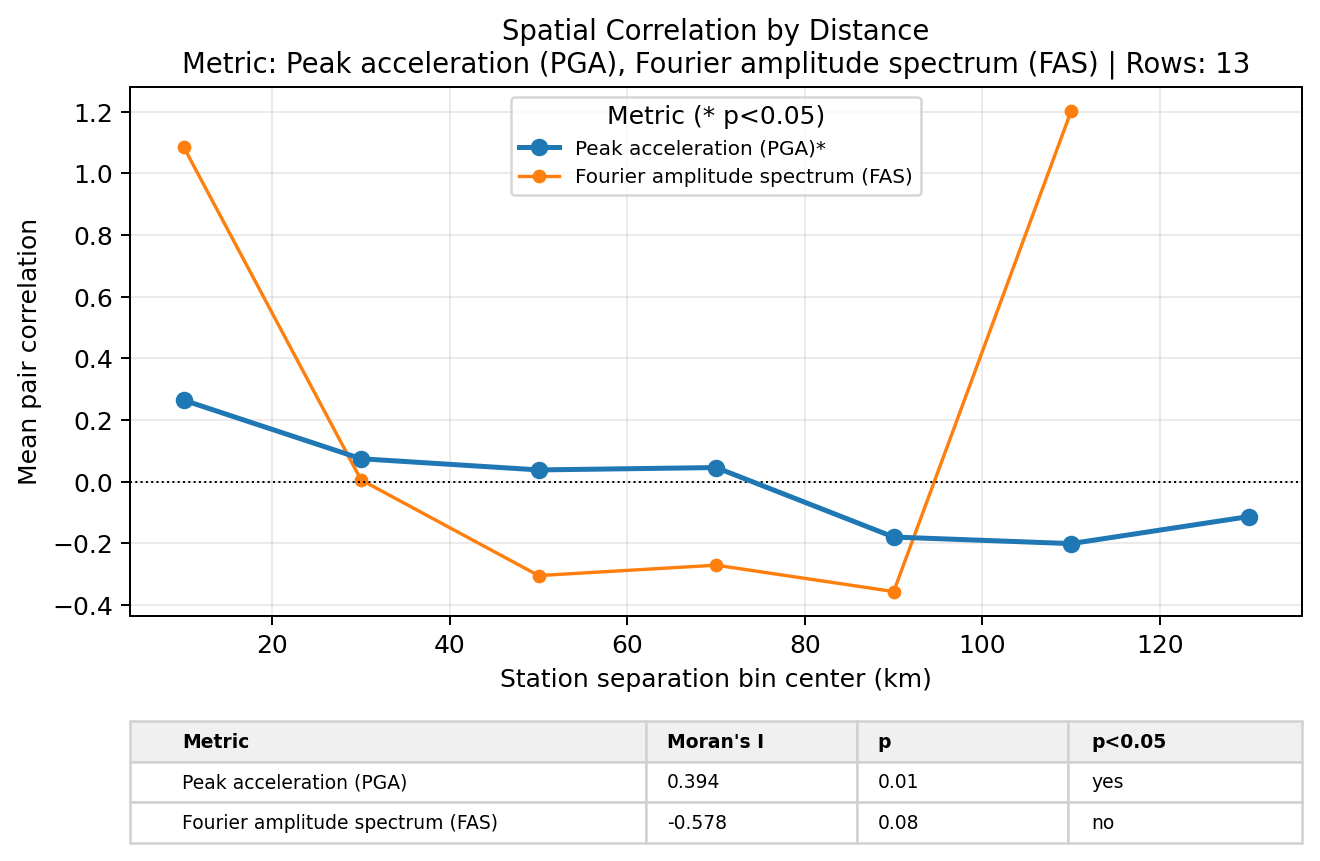
Moran’s I and distance-bin correlations help you see whether residuals cluster in space. Run them separately for each metric so the results are easier to interpret, then plot the distance-binned correlations together to compare the spatial pattern.
[6]:
moran_tables = {}
distance_bin_tables = {}

for metric_name, products in spatial_products.items():
    display(Markdown(f"### {spatial_metric_labels[metric_name]}"))

    # Compute global Moran's I for this metric's station-bias field.
    moran_result = compute_global_morans_i(products["station_bias"])

    # Convert the Moran result object into a table for saving and display.
    morans_i = moran_result_to_frame(moran_result).assign(metric=metric_name)

    # Summarize residual similarity as a function of station separation distance for this metric.
    distance_bins = build_distance_bin_summary(products["centered"]).assign(metric=metric_name)

    moran_tables[metric_name] = morans_i
    distance_bin_tables[metric_name] = distance_bins
    display(morans_i)
    display(distance_bins.head())

morans_i = pd.concat(moran_tables.values(), ignore_index=True)
distance_bins = pd.concat(distance_bin_tables.values(), ignore_index=True)

# Plot correlation as a function of station separation distance for the selected metrics.
correlation_distance_fig = plot_distance_correlation_by_metric(
    distance_bins,
    significance_df=morans_i,
    title="Spatial Correlation by Distance",
    showfig=True,
    savefig=True,
    outpath=figure_dir / "step_04_spatial_correlation_distance.png",
)

# Save the spatial-correlation result tables.
write_output_tables(
    morans_i=morans_i,
    permutation_moran=morans_i,
    distance_bin_correlations=distance_bins,
)
Peak acceleration (PGA)
| n | k | moran_i | p_two_sided | permutations | metric | |
|---|---|---|---|---|---|---|
| 0 | 30 | 2 | 0.122716 | 0.46 | 99 | PGA |
| distance_start_km | distance_end_km | distance_center_km | pair_count | event_count | mean_pair_correlation | mean_semivariance | metric | |
|---|---|---|---|---|---|---|---|---|
| 0 | 0.0 | 20.0 | 10.0 | 166 | 5 | 0.051911 | 0.371014 | PGA |
| 1 | 20.0 | 40.0 | 30.0 | 314 | 5 | 0.076451 | 0.312521 | PGA |
| 2 | 40.0 | 60.0 | 50.0 | 340 | 5 | -0.051039 | 0.482357 | PGA |
| 3 | 60.0 | 80.0 | 70.0 | 235 | 5 | -0.141052 | 0.629634 | PGA |
| 4 | 80.0 | 100.0 | 90.0 | 189 | 5 | -0.167490 | 0.621686 | PGA |
Fourier amplitude spectrum (FAS), 3 s
| n | k | moran_i | p_two_sided | permutations | metric | |
|---|---|---|---|---|---|---|
| 0 | 30 | 2 | -0.113995 | 0.45 | 99 | FAS |
| distance_start_km | distance_end_km | distance_center_km | pair_count | event_count | mean_pair_correlation | mean_semivariance | metric | |
|---|---|---|---|---|---|---|---|---|
| 0 | 0.0 | 20.0 | 10.0 | 248 | 5 | 0.007315 | 0.872195 | FAS |
| 1 | 20.0 | 40.0 | 30.0 | 487 | 5 | -0.062901 | 0.928965 | FAS |
| 2 | 40.0 | 60.0 | 50.0 | 494 | 5 | -0.017764 | 0.862055 | FAS |
| 3 | 60.0 | 80.0 | 70.0 | 371 | 5 | -0.062985 | 0.913875 | FAS |
| 4 | 80.0 | 100.0 | 90.0 | 241 | 5 | -0.035239 | 0.851155 | FAS |
[6]:
{'morans_i': PosixPath('/home/runner/work/spatial-vtk/spatial-vtk/outputs/tutorials/tables/morans_i.csv'),
 'permutation_moran': PosixPath('/home/runner/work/spatial-vtk/spatial-vtk/outputs/tutorials/tables/permutation_moran.csv'),
 'distance_bin_correlations': PosixPath('/home/runner/work/spatial-vtk/spatial-vtk/outputs/tutorials/tables/distance_bin_correlations.csv')}
Run time: 572.3 ms
Clustering and PCA Spatial Modes
These summaries group stations with similar residual fingerprints and identify dominant station-level patterns. You will create a PCA summary figure for PGA and another one for FAS.
[7]:
cluster_tables = []
cluster_score_tables = []
cluster_summary_tables = []
pca_score_tables = []
pca_loading_tables = []
pca_variance_tables = []

for metric_name, products in spatial_products.items():
    display(Markdown(f"### {spatial_metric_labels[metric_name]}"))

    # Build a station-by-event residual matrix for this metric.
    feature_table = build_station_feature_table(products["centered"])

    # Cluster stations with similar event-centered residual patterns for this metric.
    cluster_assignments, cluster_scores, cluster_features, cluster_summary, best_cluster, cluster_feature_columns = run_residual_feature_clustering(feature_table)

    # Decompose this metric's station residual patterns into PCA spatial modes.
    pca_result = compute_pca_spatial_modes(feature_table)

    # Plot the PC1 map, explained variance, and feature loading summary for this metric.
    pca_summary_fig = plot_pca_summary(
        pca_result.station_scores,
        pca_result.explained_variance,
        pca_result.feature_loadings,
        mode="PC1",
        title=f"{spatial_metric_labels[metric_name]} PCA Spatial Mode Summary",
        add_basemap=True,
        showfig=True,
        savefig=True,
        outpath=figure_dir / f"step_04_{metric_name.lower()}_pca_summary.png",
    )

    cluster_tables.append(cluster_assignments.assign(metric=metric_name))
    cluster_score_tables.append(cluster_scores.assign(metric=metric_name))
    cluster_summary_tables.append(cluster_summary.assign(metric=metric_name))
    pca_score_tables.append(pca_result.station_scores.assign(metric=metric_name))
    pca_loading_tables.append(pca_result.feature_loadings.assign(metric=metric_name))
    pca_variance_tables.append(pca_result.explained_variance.assign(metric=metric_name))
    display(pca_result.explained_variance)

clusters = pd.concat(cluster_tables, ignore_index=True)
cluster_scores = pd.concat(cluster_score_tables, ignore_index=True)
cluster_summary = pd.concat(cluster_summary_tables, ignore_index=True)
pca_station_scores = pd.concat(pca_score_tables, ignore_index=True)
pca_feature_loadings = pd.concat(pca_loading_tables, ignore_index=True)
pca_explained_variance = pd.concat(pca_variance_tables, ignore_index=True)

# Save clustering and PCA tables for the mapping notebook.
write_output_tables(
    clusters=clusters,
    cluster_scores=cluster_scores,
    cluster_summary=cluster_summary,
    pca_station_scores=pca_station_scores,
    pca_feature_loadings=pca_feature_loadings,
    pca_explained_variance=pca_explained_variance,
)
Peak acceleration (PGA)
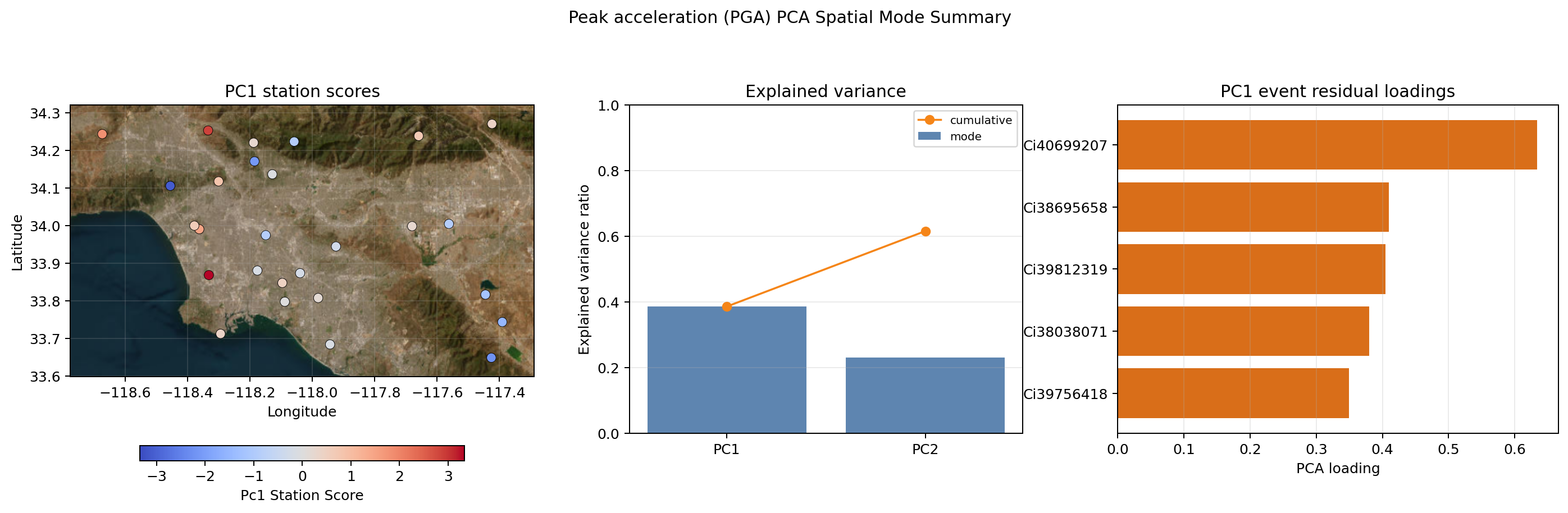
| mode | mode_index | explained_variance | explained_variance_ratio | cumulative_explained_variance_ratio | singular_value | n_stations | n_features | standardized | |
|---|---|---|---|---|---|---|---|---|---|
| 0 | PC1 | 1 | 2.592492 | 0.501215 | 0.501215 | 8.670771 | 30 | 5 | True |
| 1 | PC2 | 2 | 0.986044 | 0.190635 | 0.691850 | 5.347456 | 30 | 5 | True |
Fourier amplitude spectrum (FAS), 3 s
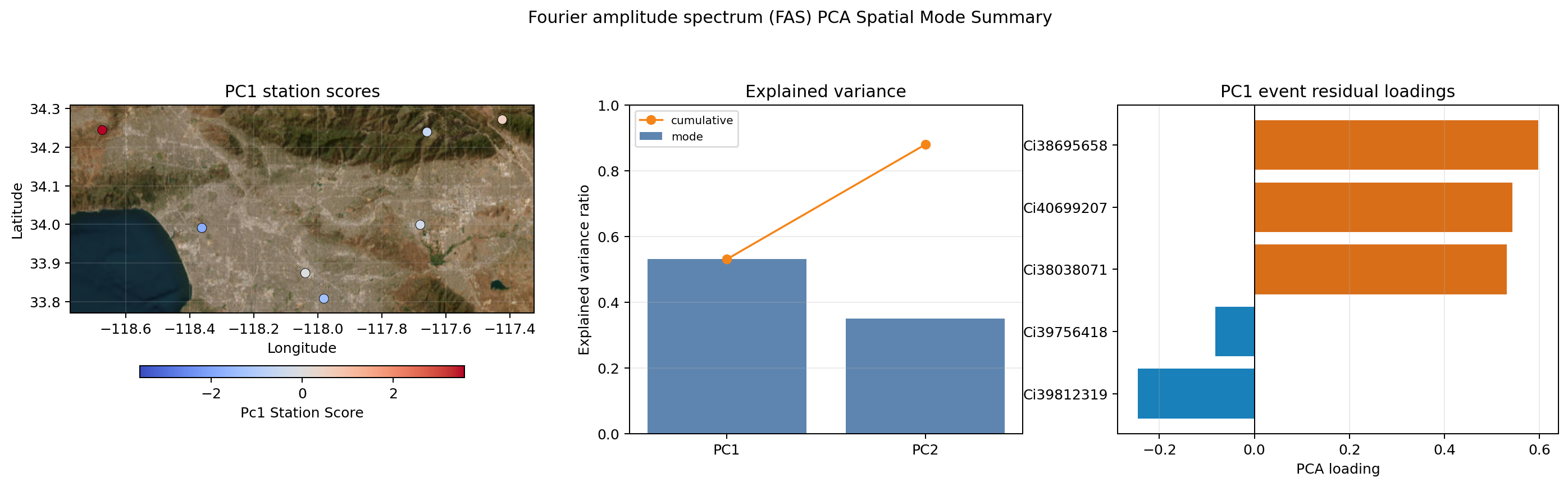
| mode | mode_index | explained_variance | explained_variance_ratio | cumulative_explained_variance_ratio | singular_value | n_stations | n_features | standardized | |
|---|---|---|---|---|---|---|---|---|---|
| 0 | PC1 | 1 | 1.567109 | 0.302974 | 0.302974 | 6.741376 | 30 | 5 | True |
| 1 | PC2 | 2 | 1.209353 | 0.233808 | 0.536783 | 5.922098 | 30 | 5 | True |
[7]:
{'clusters': PosixPath('/home/runner/work/spatial-vtk/spatial-vtk/outputs/tutorials/tables/clusters.parquet'),
 'cluster_scores': PosixPath('/home/runner/work/spatial-vtk/spatial-vtk/outputs/tutorials/tables/cluster_scores.csv'),
 'cluster_summary': PosixPath('/home/runner/work/spatial-vtk/spatial-vtk/outputs/tutorials/tables/cluster_summary.csv'),
 'pca_station_scores': PosixPath('/home/runner/work/spatial-vtk/spatial-vtk/outputs/tutorials/tables/pca_station_scores.parquet'),
 'pca_feature_loadings': PosixPath('/home/runner/work/spatial-vtk/spatial-vtk/outputs/tutorials/tables/pca_feature_loadings.csv'),
 'pca_explained_variance': PosixPath('/home/runner/work/spatial-vtk/spatial-vtk/outputs/tutorials/tables/pca_explained_variance.csv')}
Run time: 3.56 s
Geology Contrasts
Compare PGA and FAS residuals across the configured geology classes. GeoJSON regions and corridors are handled in the next notebook.
[8]:
geology_tables = []

for metric_name, products in spatial_products.items():
    display(Markdown(f"### {spatial_metric_labels[metric_name]}"))

    # Compare configured geology classes with an event-bootstrap uncertainty estimate for this metric.
    geology_contrast = bootstrap_contrast_table(products["centered"], station_metadata=site_metadata).assign(metric=metric_name)

    # Plot the residual distributions and annotate the configured geology-class contrast for this metric.
    geology_contrast_fig = plot_geology_contrast(
        products["centered"],
        station_metadata=site_metadata,
        contrast_df=geology_contrast,
        title=f"{spatial_metric_labels[metric_name]} Residuals by Geology Class",
        showfig=True,
        savefig=True,
        outpath=figure_dir / f"step_04_{metric_name.lower()}_geology_contrast.png",
    )

    geology_tables.append(geology_contrast)
    display(geology_contrast)

geology_contrasts = pd.concat(geology_tables, ignore_index=True)

# Save the geology contrast output for later review.
write_output_tables(geology_contrasts=geology_contrasts)
Peak acceleration (PGA)
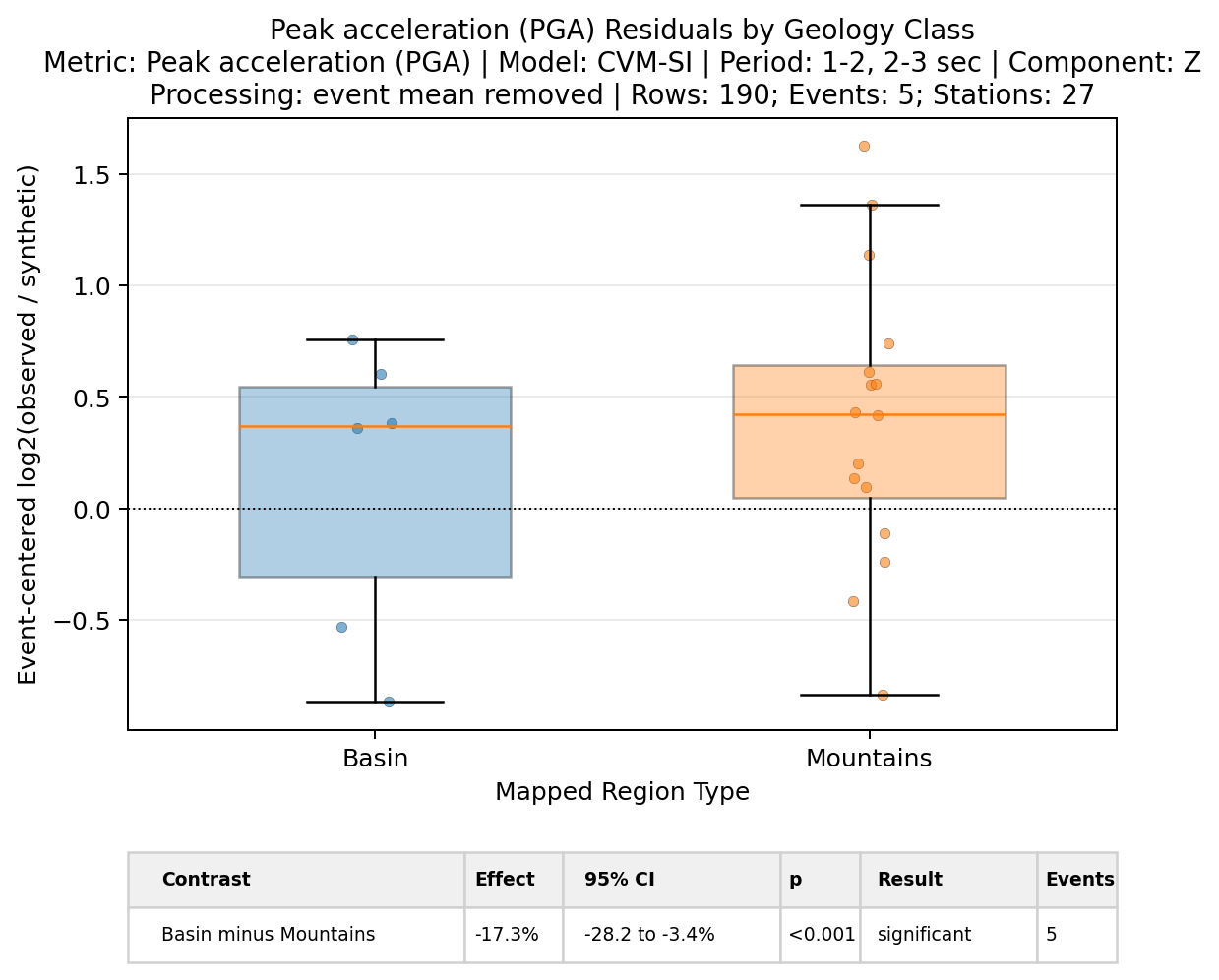
| group_col | left_values | right_values | comparison_values | baseline_values | contrast_label | effect_direction | value_col | statistic | min_stations_per_group | ... | bootstrap_p | significant_95 | significant_p05 | n_left_stations | n_right_stations | n_comparison_stations | n_baseline_stations | n_events | bootstrap_samples_used | metric | |
|---|---|---|---|---|---|---|---|---|---|---|---|---|---|---|---|---|---|---|---|---|---|
| 0 | mapped_region_type | Basin | Mountains | Basin | Mountains | Basin minus Mountains | mean(Basin) - mean(Mountains) | field_centered | mean | 1 | ... | 0.0 | True | True | 1 | 2 | 1 | 2 | 5 | 100 | PGA |
1 rows × 26 columns
Fourier amplitude spectrum (FAS), 3 s
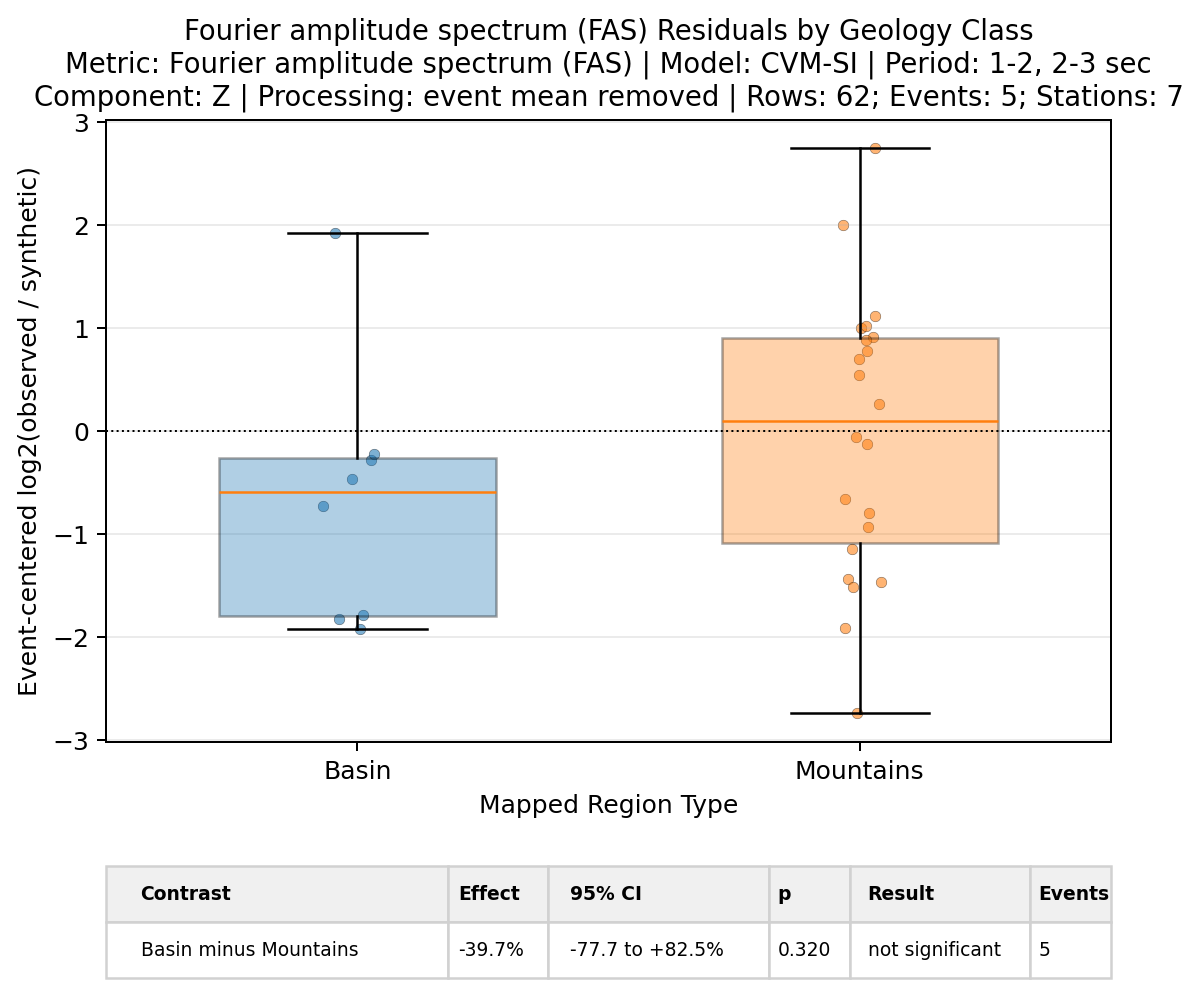
| group_col | left_values | right_values | comparison_values | baseline_values | contrast_label | effect_direction | value_col | statistic | min_stations_per_group | ... | bootstrap_p | significant_95 | significant_p05 | n_left_stations | n_right_stations | n_comparison_stations | n_baseline_stations | n_events | bootstrap_samples_used | metric | |
|---|---|---|---|---|---|---|---|---|---|---|---|---|---|---|---|---|---|---|---|---|---|
| 0 | mapped_region_type | Basin | Mountains | Basin | Mountains | Basin minus Mountains | mean(Basin) - mean(Mountains) | field_centered | mean | 1 | ... | 0.72 | False | False | 1 | 2 | 1 | 2 | 5 | 100 | FAS |
1 rows × 26 columns
[8]:
{'geology_contrasts': PosixPath('/home/runner/work/spatial-vtk/spatial-vtk/outputs/tutorials/tables/geology_contrasts.csv')}
Run time: 965.8 ms